-
94,000+
Farmers trained on CBB identification and pest management
-
500,000+
Insect traps installed across Uganda
-
80%
Reduction in CBB infestation on treatment farms in Central Uganda
“I feel very confident about assembling and maintaining the beetle traps on my own. I believe I have learned everything from the training well, and I am confident I can teach other farmers how to do it too.”
The Challenge
Coffee berry borer (Hypothenemus hampei) is one of the most economically damaging pests of coffee. Originating in Africa, it has spread to all coffee-growing regions of the world. The adult female beetle bores into coffee berries to lay eggs inside the seed. These develop into larvae that feed on the bean, destroying the cherry and reducing yield and coffee quality. Infestation can go unnoticed until harvest: Tiny holes appear on the coffee cherry's skin, while the beans are eaten from the inside. Most of the life cycle of the berry borer occurs inside the berry, where the eggs, larvae, and adult beetles are protected from predators and insecticides. For this reason, the borer is particularly difficult to control.
In Uganda, farmers are often unaware of the presence of CBB, and if they are aware, they have no means to control the infestation.


Our Approach
Enveritas set out to build farmer capacity to detect and manage CBB across Uganda. The program's initial phase, in 2019–2020, covered more than 30 districts across both Arabica- and Robusta-growing areas. The second phase, in 2024–2025, reached 50,000+ farms in Central Uganda and the Elgon region.
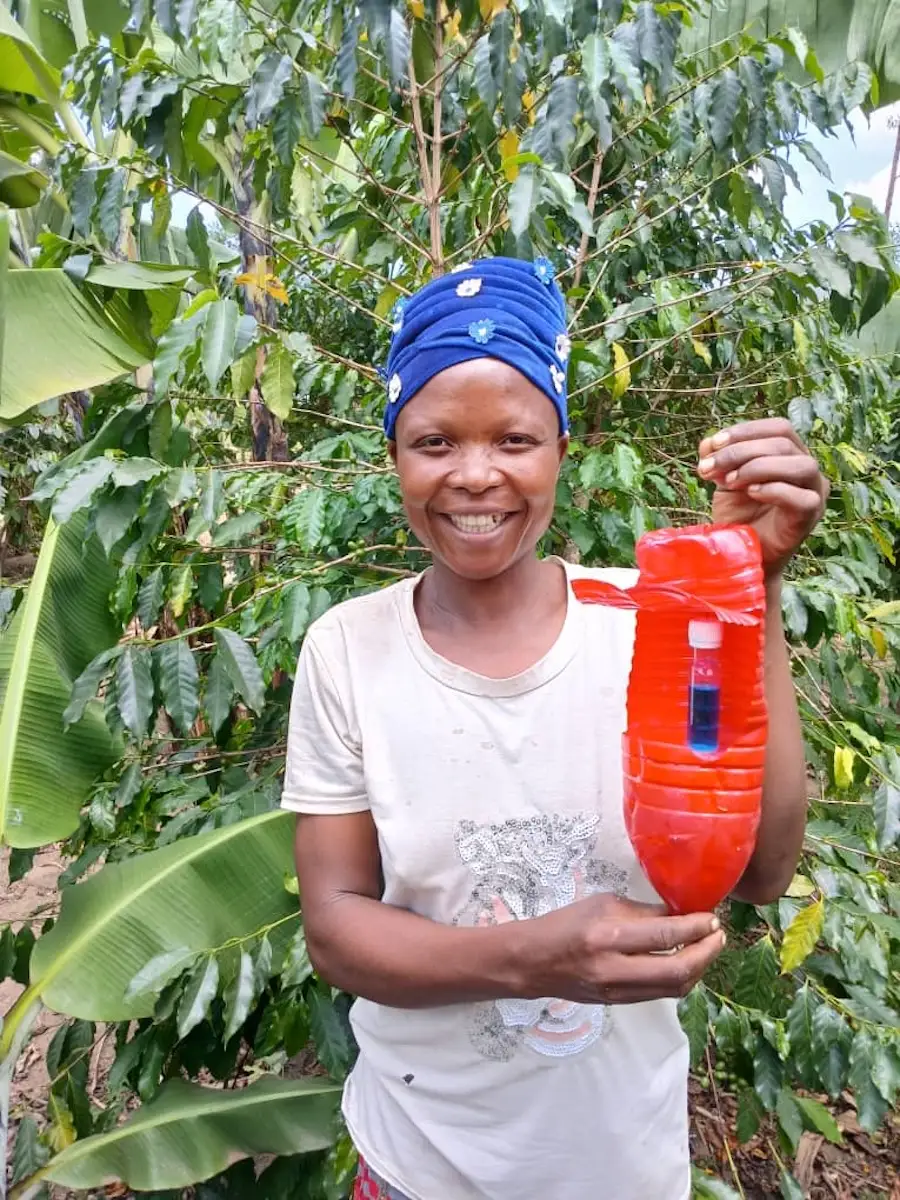
The intervention combined group lessons with individual farm visits. Field staff trained farmers on CBB identification and beetle trap construction, as well as integrated pest management and farm hygiene practices. Farmers built the traps themselves from recycled plastic bottles and were trained in maintaining them, ensuring the approach could outlast the program. Field staff followed up to reinforce key practices and support trap installation.
Knowledge retention and adoption were monitored six and nine months after the intervention. More than 90% of trained farmers could identify CBB damage and three out of four traps were still intact, correctly positioned, and with borer attractant nine months after training.


Measuring CBB Infestation
Understanding CBB infestation rates on farms across Uganda was important both for assessing the magnitude of the infestation—with some sources suggesting that 10%, 20%, or more of the cherries could be infected—and for enabling a program like ours to target highly affected regions. A protocol was developed to assess infestation and rolled out across more than 7,000 farms, with field staff sampling a random selection of trees and branches to determine the share of affected cherries.

Alongside the main rollout of traps, a study across 900 farms evaluated the effects of the traps and trainings on infestation rates and yields. The farms, from 48 villages in Central Uganda and the Elgon region, were split into treatment and control groups, with CBB infestation tracked at baseline, six months, and nine months.
A sample of trap contents was also examined to determine which beetle species were being caught. Several species of borers were present, including the black twig borer (BTB; Xylosandrus compactus), a significant pest of Robusta coffee trees in Uganda that is indistinguishable from CBB to the naked eye. Using a microscope, field teams observed over 1,000 beetles collected from more than 100 traps across 34 farms to assess the proportion of BTB and CBB in the traps.


Findings
Our research showed that an average of 4–6% of red cherries across Uganda were affected by CBB. This is considerable in terms of yield loss, but lower than we had anticipated. Higher infestation rates were found at lower elevations, where CBB reproduces faster.
Our assessment of trap contents showed that around 5% of beetles caught were BTB, versus 95% CBB.
The study showed strong results for the program in Central Uganda, with treatment farms seeing infestation rates fall by around 80% over nine months but no such decline in control farms. Treatment farms in the region also achieved around 10% higher yields than control farms, although high variance made this result inconclusive. In Mount Elgon, infestations declined across all farms, with no detectable treatment effect.
While traps were shown to have a valuable effect, at least in our Robusta study, the return on investment did not meet our target threshold, primarily due to the lower than expected average infestation rates we found in Uganda.


